UK businesses face supply-chain, trade & workforce pressures: ONS
Sep 01, 2026

UK businesses continued to face pressure from economic uncertainty, labour costs and energy prices in August 2026, while turnover expectations remained broadly stable, according to the latest Business Insights and Impact on the UK Economy release from the Office for National Statistics (ONS), published on August 20.
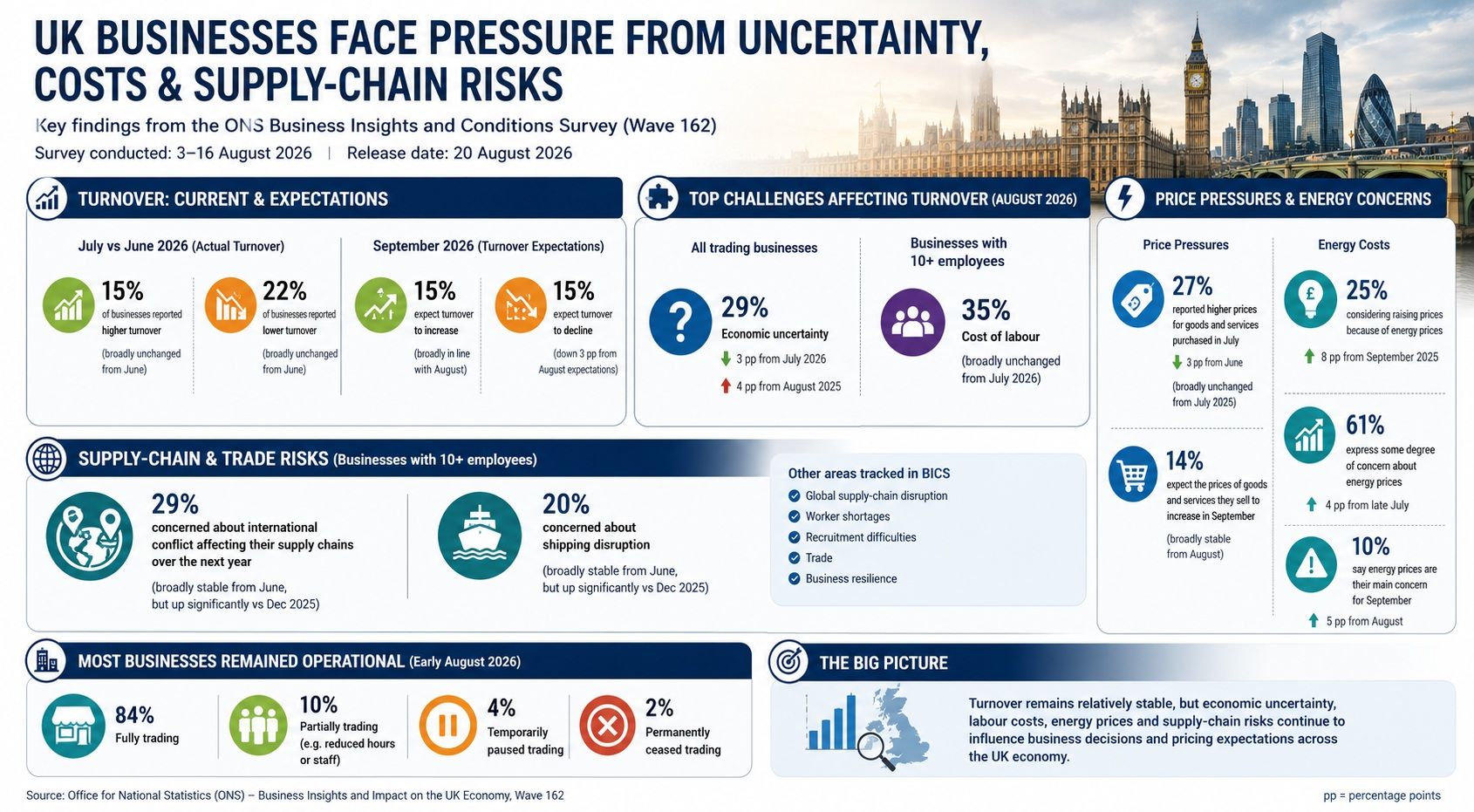
The latest findings from Wave 162 of the Business Insights and Conditions Survey (BICS), conducted from August 3 to 16, show that 15 per cent of trading businesses reported higher turnover in July compared with June, broadly unchanged from the previous month. Meanwhile, 22 per cent reported lower turnover, also broadly stable.
Among trading businesses, economic uncertainty was the most reported challenge affecting turnover in August, cited by 29 per cent, down 3 percentage points from July but 4 percentage points higher than in August 2025. For businesses with 10 or more employees, cost of labour was the leading challenge at 35 per cent, broadly unchanged from July.
Looking ahead, 15 per cent of trading businesses expect turnover to increase in September, broadly in line with August expectations. Another 15 per cent expect turnover to decline, down 3 percentage points from the previous month’s expectations.
Energy and price pressures remain important
Price pressures continued to affect businesses. Twenty-seven per cent of trading businesses reported higher prices for goods and services purchased in July, down 3 percentage points from June and broadly unchanged from July 2025.Meanwhile, 14 per cent expect the prices of goods and services they sell to increase in September, broadly stable from August. Energy costs are becoming a greater consideration: 25 per cent of trading businesses said they were considering raising prices because of energy prices, up 8 percentage points from September 2025.
Meanwhile, 14 per cent expect the prices of goods and services they sell to increase in September, broadly stable from August. Energy costs are becoming a greater consideration: 25 per cent of trading businesses said they were considering raising prices because of energy prices, up 8 percentage points from September 2025.
Energy prices were also a significant business concern. Sixty-one per cent of businesses expressed some degree of concern about energy prices in early August, up 4 percentage points from late July. Furthermore, 10 per cent said energy prices were their main concern for September, up 5 percentage points from August.
Supply-chain and trade risks
The BICS also tracks global supply-chain disruption, worker shortages, recruitment difficulties, trade and business resilience. These indicators remain particularly relevant for textile exporters, apparel manufacturers, importers and retail sourcing teams, given their exposure to UK consumer demand, labour costs, energy prices and international logistics.
In the previous BICS release, 29 per cent of businesses with 10 or more employees said they were concerned about international conflict affecting their supply chains over the following year, while 20 per cent were concerned about shipping disruption. Both measures were broadly stable from June but had risen significantly compared with December 2025.
Most businesses remained operational
The latest data show that 94 per cent of businesses were trading in early August, with 84 per cent fully trading and 10 per cent partially trading, such as operating with reduced hours or staff numbers. A further 4 per cent had temporarily paused trading, while 2 per cent had permanently ceased trading.
Overall, the latest data point to a UK business environment in which turnover remains relatively stable, but economic uncertainty, labour costs, energy prices and supply-chain risks continue to influence business decisions and pricing expectations.