UK labour productivity rebounds to 1.1% growth after years of decline
Sep 01, 2026

United Kingdom (UK) labour productivity shows signs of a measured revival in administrative tax data, a development relevant for retail, apparel and other labour-intensive supply chains tracking wage pressure, staffing levels and output per hour in the UK.
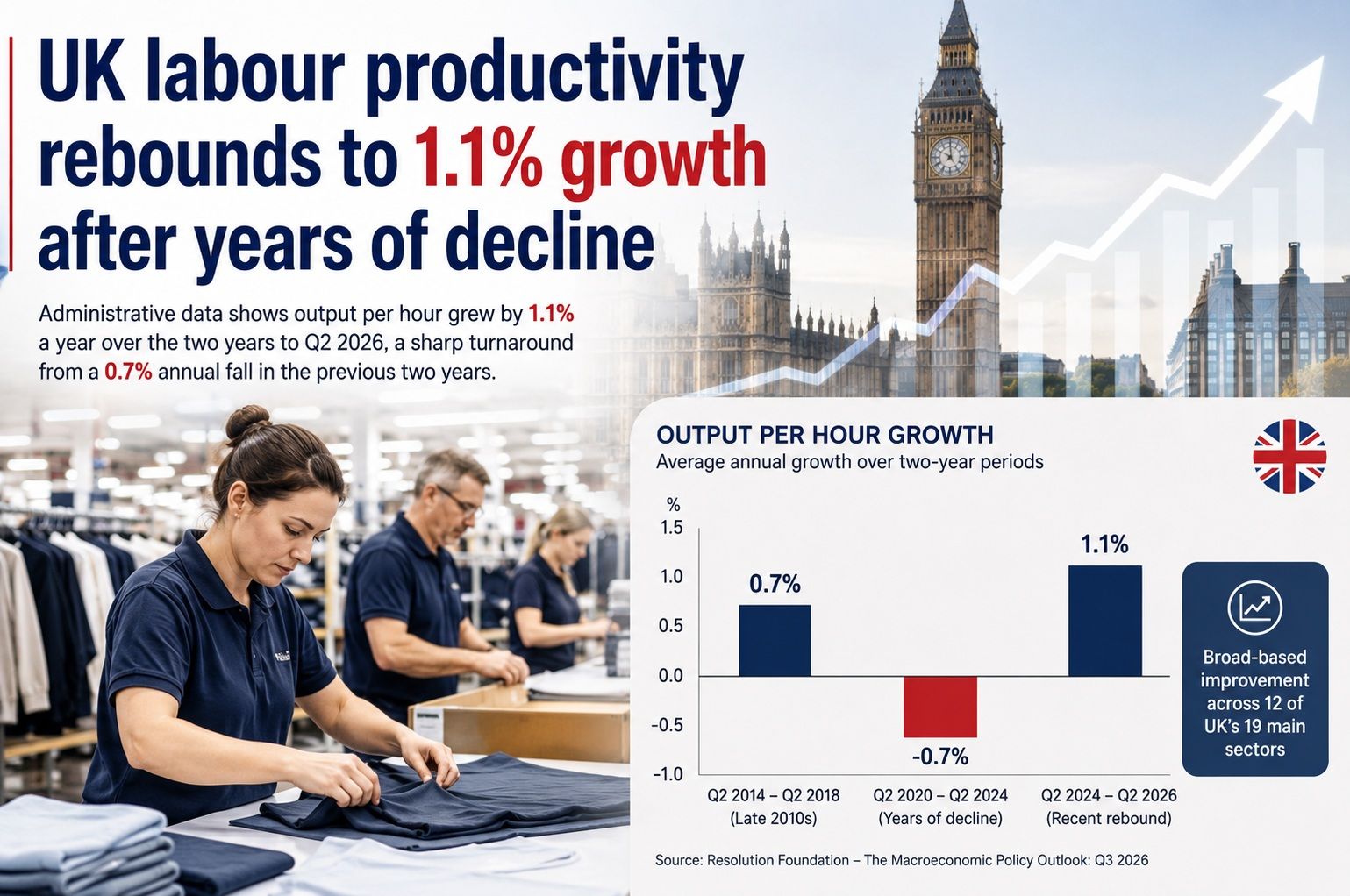
The analysis says output per hour grew by 1.1 per cent a year over the two years to Q2 2026. That marked a sharp turnround from a 0.7 per cent a year fall in the previous two years and was also faster than the 0.7 per cent growth rate recorded in the late 2010s.
The Resolution Foundation said in its The Macroeconomic Policy Outlook: Q3 2026 that the improvement appears genuine and broad-based. It said 12 of the UK’s 19 main sectors contributed to the pickup, indicating that the aggregate figure was not being lifted by one part of the economy alone.
The Office for National Statistics’ (ONS) headline output-per-hour measure, which is underpinned by the LFS Labour Force Survey (LFS), was around 5 per cent below the level implied by the Office for Budget Responsibility’s (OBR) final pre-Covid forecast in Q2 2026, according to the outlook. The foundation said that gap equated to lost output of around £150 billion (~$205 billion) a year, or around £4,500 (~$6,200) a year per worker.
The report said LFS-based output per hour fell by an average of 0.2 per cent a year over the two years to Q2 2026, after falling by 0.1 per cent a year in the two years before that. By contrast, the foundation’s preferred admin-based estimates showed a move from an average fall of 0.7 per cent a year to growth of 1.1 per cent a year over the same two periods.
In 2025, the LFS recorded employment growth of 1.7 per cent, while administrative data recorded a fall of 0.1 per cent. The foundation said that gap was more likely to reflect survey improvements than genuine employment growth, adding that the ONS has advised users since May 2026 to focus on administrative-data estimates as the best guide to how productivity is changing.
The foundation said two more reliable measures both pointed to productivity growth of 1.1 per cent a year over the past two years: the ONS Workforce Jobs measure and the foundation’s admin-based estimate. It also said the OBR’s revised medium-term assumption for UK productivity growth, at around 1 per cent, is now broadly in line with measured reality.
The report found little evidence that the pickup was caused by low-productivity sectors such as retail and hospitality shrinking, or by employers shedding low-paid jobs as employer National Insurance and the minimum wage rose. It said almost all the improvement came from faster productivity growth within sectors, not from the reallocation of hours between them.
Across around 400 occupations, growth in below-median-paid roles was 2 percentage points stronger in the year to April 2025 than growth in jobs above median pay.
The foundation also said capital deepening does not explain the improvement, as investment has been flat at 19 per cent of gross domestic product since 2023 and would need to rise sharply or for a sustained period to move productivity by this much. It described the recent improvement as looking like total factor productivity growth.
The outlook said it is probably too early to attribute the apparent revival to artificial intelligence. Although nearly half of UK businesses are using AI in some form, only around one in twenty firms say they are using it extensively, suggesting it is not yet deeply embedded across the economy.
In accounting terms, the foundation said stronger productivity growth came mainly from flatlining hours rather than faster output growth. Over the two years to Q2 2026, gross domestic product (GDP) grew by 1.3 per cent a year while hours worked grew by only 0.2 per cent a year. In the two years to Q2 2024, GDP grew by 0.9 per cent a year while hours worked rose by 1.6 per cent a year.
Three-quarters, or 77 per cent, of the pickup in productivity growth between those two periods came from slower hours growth. Compared with Q1 2016 to Q4 2019, when GDP grew by 2.0 per cent and hours worked by 1.3 per cent on average, the recent higher productivity rate was entirely due to weaker growth in hours worked.
For UK-facing sourcing and retail teams, the report leaves a cautiously positive but unresolved message: workers across the economy appear to be producing more, while the least productive parts of the economy are not simply shrinking. The foundation said the revival looks genuine, though its cause remains unclear.